
Why are there disputes about the Kalevala?
- There are ongoing disputes about the origins of the Kalevala and the tradition and culture it represents.
- The Kalevala is both Finnish and Karelian. Elias Lönnrot was Finnish-speaking and created the epic for a Finnish audience; however, most of the source poems are Karelian.
- The Kalevala remains relevant also in the modern world. It was referenced in #MeToo discussions in the 2010s, as it portrays tensions between genders and their social roles.
There have been disputes surrounding the Kalevala ever since it was published. These have centered on its authenticity and its position as Finnish and Karelian cultural heritage.
Is the Kalevala cultural appropriation?
Cultural appropriation refers to the use or appropriation of elements of a minority culture by a hegemonic group. In present-day Finland, some members of the Karelian speaking minority feel that the Kalevala has been taken from the Karelians, as a large proportion of the source poems used by Lönnrot are Karelian.
In creating the Kalevala, Lönnrot used folk poems from another cultural region, Karelia, and employed them as the foundation for an epic that came to be regarded as representing the essence of Finnishness. In the 19th century, however, cultural appropriation was not a recognized concept, and Lönnrot did not consider himself to have stolen or misappropriated cultural elements from the Karelian people. As the languages spoken on both sides of the Karelian border were very similar – though different dialects – the region was viewed as a part of Finnish culture in a broader sense.
To whom does the Kalevala belong?
The Kalevala is Finland’s national epic and an integral part of Finnish culture and identity. At the same time, it is also Karelia’s epic and a part of Karelian language and culture. Beyond this, the Kalevala is a work of literature that belongs to all who read it and are inspired by it. When discussing the ownership of a work of art, it can, first and foremost, be considered from the perspective of its the creator. In the case of the Kalevala, this refers to Elias Lönnrot.
The Kalevala and gender rights in the 2020s
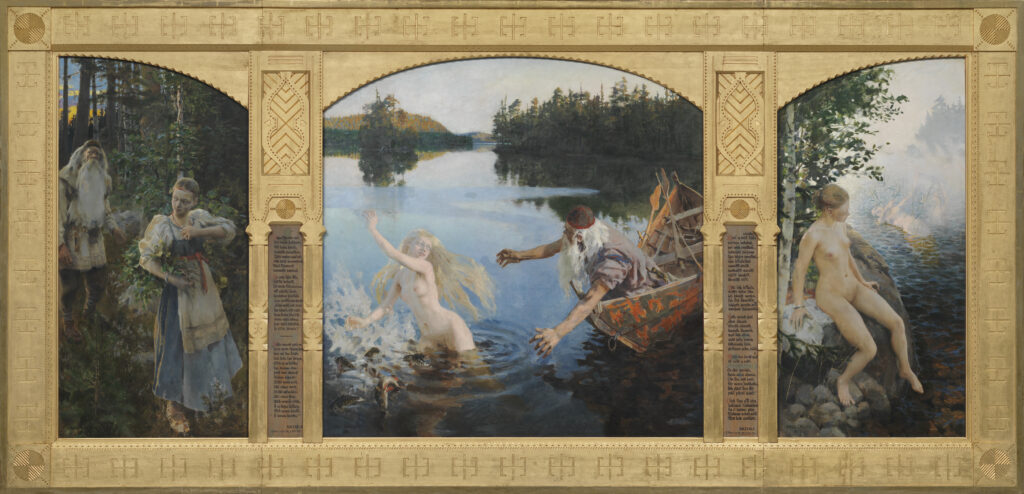
The Kalevala can also be used as a lens through which to address questions related to gender identity and equality. When global discussions about sexual harassment of women gained momentum in 2017 with the #MeToo movement, the Kalevala appeared in public debate, particularly in connection with a well-known painting of Aino by the artist Akseli Gallen-Kallela. Väinämöinen of the Kalevala, as depicted by Gallen-Kallela, was interpreted as an old man who sexually harasses women, and calls were made for the Aino in the Ateneum Art Museum to be removed from exhibition. Some voices even demanded that the Kalevala itself should be banned because of what were seen as unethical gender representations.
However, it is important to distinguish between Gallen-Kallela’s paintings and Lönnrot’s Kalevala. While Gallen-Kallela’s interpretation presents Väinämöinen as an old man pursuing a young woman, the episode is not depicted in exactly the same way in the Kalevala. Instead, the epic places greater emphasis on how the balance of the community is disturbed when a young woman encounters an unknown suitor. In the pre-modern world depicted in the Kalevala, women were expected to marry in order to secure their future. The Aino poem explores the limited choices available to a young woman and reflects ideas about women and their position in society that were considered modern in the 19th century.
Music
Ruosteen synty (The Origin of Rust)
Helena Taskila, incantation
Erja Pätsi, jouhikko
Petteri Wiander, 5-string kantele and bow
Track on Vimeo